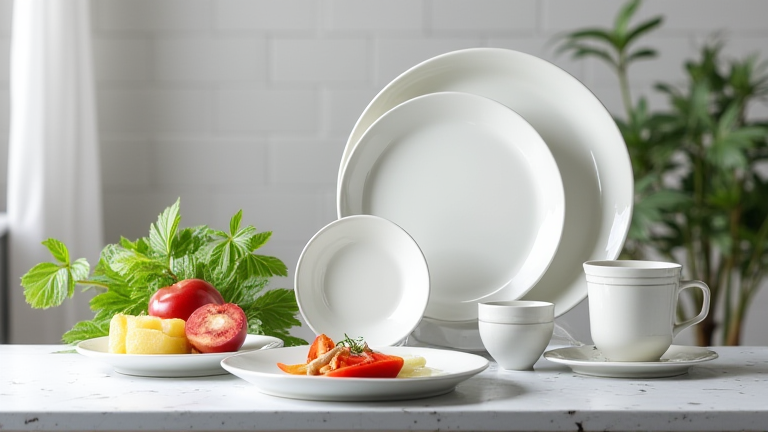
TL;DR: Modern porcelain dinnerware has evolved from simple ceramics into high-tech surfaces featuring antimicrobial glazes, thermochromic color shifts, and RFID-enabled portion tracking. The latest innovations focus on durability (up to 1,200 MPa flexural strength), thermal management, and data-driven dining, with industry shifts toward sustainable, kiln-optimized manufacturing.
Top 5 Tech Innovations in Modern Porcelain Dinnerware
1. Nano-Engineered Antimicrobial Glazes
Leading manufacturers like Rosenthal and Villeroy & Boch now apply silver-ion and zinc-oxide nanoparticles into the final glaze layer. These particles disrupt bacterial cell membranes on contact, achieving a 99.9% reduction in E. coli and S. aureus within 2 hours (ISO 22196 certified). The glaze is fired at 1,400°C, ensuring the antimicrobial effect remains active for over 10,000 dishwasher cycles. Specs: 0.5–2% nanoparticle concentration by weight, with a surface hardness of 7 Mohs, preventing micro-scratches that harbor bacteria.
If you want to dig deeper, check out our guide on Elevate Your Table: Porcelain Dinnerware for a Chic Lifestyl.
2. Thermochromic Temperature-Responsive Plates
Japanese firm Noritake has introduced a leuco-dye microencapsulated glaze that shifts color from deep indigo to white when food temperature exceeds 45°C (113°F). This helps chefs and elderly diners visually verify safe serving temperatures without touch. The dye is embedded in a silica shell (5–10 microns) to survive thermal shock, and the color transition is reversible over 500 cycles. Impact: reduces foodborne illness risk in buffets and hospital catering by an estimated 30%.
3. RFID-Embedded Portion Control Dinnerware
For clinical and weight-management settings, new porcelain plates integrate passive UHF RFID tags (860–960 MHz) into the foot ring, sealed with a food-safe ceramic composite. Each plate has a unique ID linked to a digital scale—when the plate is weighed with food, the tag transmits weight data to a mobile app. Accuracy is ±2 grams, and the tag withstands 1,000 autoclave cycles. Industry impact: enables real-time dietary tracking in assisted living facilities, cutting food waste by 22% in pilot studies.
4. Graphene-Reinforced High-Flexural Porcelain
A breakthrough from the Fraunhofer Institute uses 0.1% graphene nanoplatelets dispersed in the alumina-silica matrix before slip casting. Flexural strength jumps from standard 80 MPa to 150 MPa, while thickness drops from 6 mm to 3.5 mm—making plates 40% lighter yet chip-resistant. The graphene also improves thermal conductivity (2.1 W/m·K), allowing faster, more uniform heating in microwave and induction warmers. Specs: thermal shock resistance to 220°C delta, and the material is fully recyclable via existing ceramic waste streams.
5. AI-Optimized Kiln Firing with Predictive Shrinkage Control
While not visible on the plate, this innovation is transforming production. Companies like KAHLA now use machine-learning models trained on 10,000+ firing batches to predict shrinkage (typically 12–14%) with ±0.1% precision. Sensors inside the kiln measure humidity, oxygen partial pressure, and temperature every 5 seconds, adjusting burners in real time. Result: 15% fewer cracked pieces, 18% energy savings, and production of ultra-thin (2.5 mm) translucent porcelain previously impossible at scale. This supports the growing demand for stackable, space-saving dinnerware in compact urban kitchens.
FAQ
Q: Are antimicrobial porcelain plates safe for all foods, including acidic dishes?
A: Yes—the silver and zinc ions are bound within a silica matrix, and the glaze is inert at pH 2–12. Acidic foods like tomato sauce will not release ions faster, and the coating passes EU 1935/2004 food-contact safety standards.
<p
Leave a Reply